Touch and hearing for Monty: links, graphs, points
Everything here is measured on tbp.monty main at v0.58.0 (335c1aa), 2026-11-14.
OK. So I finally think I’ve got the brain in a place where I want it. Below you will find links to my forks and my results from all the coding on Monty I’ve been doing lately. Now that I think I get how different senses help one another, I’m going to head back into the shop to work on some more robots!
Below you will find the camera-free touch, instructions on how the MuJoCo stuff is wired in, and the limitations of the experiments. Its seems clear to me that thinking creatively about what a sense is doing and how that transforms into a graph in Monty can result in fewer steps before recognition.
Please let me know if y’all have any questions, and if I did anything wildly wrong here. Its been a busy hunting season at the ol’ wildlife management agency, but I’m glad to have my nose back in this gut pile.
Git links
| Touch | Hearing | |
|---|---|---|
| Branch | touch-mujoco | audio-sensor-module-v058 |
| What changed against their main | compare, 3 commits, 94 files | compare, 1 commit, 34 files |
| Open a pull request | start the PR form | start the PR form |
Touch, the files worth pointing at:
- agents.py:
TouchConfig, the fingertip that reads the contact solver - sensor_modules.py:
TouchSM, the sensor module with no camera in it - motor_policies.py:
TouchSurfacePolicy, steering by touch alone - textures.py: recorded texture
- touch_test.py: the finger’s readings checked against simple shapes
Hearing:
- AUDIO.md: the write-up, with how to run it
- models/audio: the ear
- the dataset, audio-riffs-v1: seven guitar takes, 89 MB
- the October branch, unchanged, in case anyone has the old link
Graphs
The files are in this folder: /home/bryan/MontySAI/experiments/touch/forum/. forum_graphs.py one folder up redraws them.
1. The finger gets rid of the eye’s long tail
1_recognition_race.png

2. Any one sense sometimes gets stuck. Two never did.
2_every_episode.png

3. Which objects the finger rescues
3_object_by_object.png

4. Hearing: every miss gets the tune right
4_hearing.png

Two more hearing pictures are already in the fork and can be linked directly:
The main points
Touch
- Monty was already computing touch and throwing it away. MuJoCo’s contact solver works out every contact on every step. The finger reads it: where it touches, which way the surface faces, how hard it pushes back, how slick it is. Nothing is fitted on top. Texture is the one part that needs outside data (recorded strokes from the Penn Haptic Texture Toolkit).
- The finger has no camera in it and names 49 YCB objects by itself: 147 of 147 on rotations it trained on, 145 of 147 on rotations it never saw.
- Eye and finger voting: 300 of 300 on trained rotations, 298 of 300 on new ones. The one miss is a Phillips screwdriver called a flat one.
- The finger gets rid of the eye’s long tail. On new rotations every eye + finger episode settles by step 52. The eye alone runs out the 500-step clock 7 times in 150.
- Mean steps halve, 57.7 to 27.5. The typical episode does not change (median 27.5 against 27). The gain is all in the stuck ones.
- The stuck ones are thin tools. Eye alone, then with the finger: flat screwdriver 457 to 32 steps, Phillips screwdriver 349 to 33, spoon 290 to 33, knife 192 to 27, fork 191 to 33.
- Every sense alone gets stuck sometimes. The pair is the only row with no episode at the limit.
- Shape alone is enough, slowly: contact normal and felt curvature name all 49 objects on both sets of rotations, in about 100 steps.
- One it cannot do: the finger alone cannot learn the skillet lid. It keeps slipping off the rim.
- It runs on the current release with 26 new tests. Eye + finger scores exactly what it did on the older base from previous surface-policy fixes; the finger alone lost two objects on new rotations (the two screwdrivers, confused with each other).
Hearing
- An ear as a sensor module: a CARFAC cochlea and a stabilized auditory image, turned into feature-at-location like any other sensor. Learning and recognition are stock Monty. No learning module code changed.
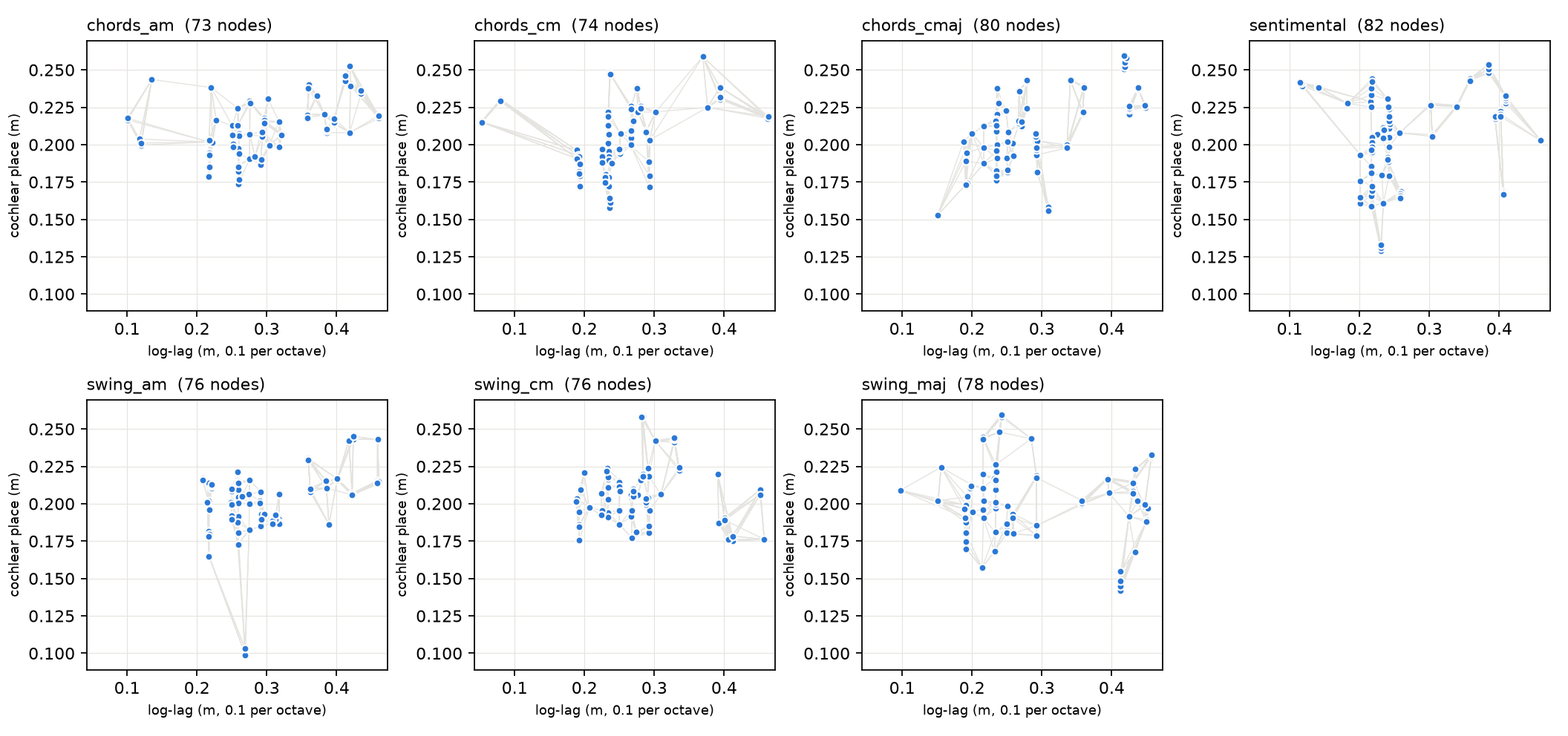
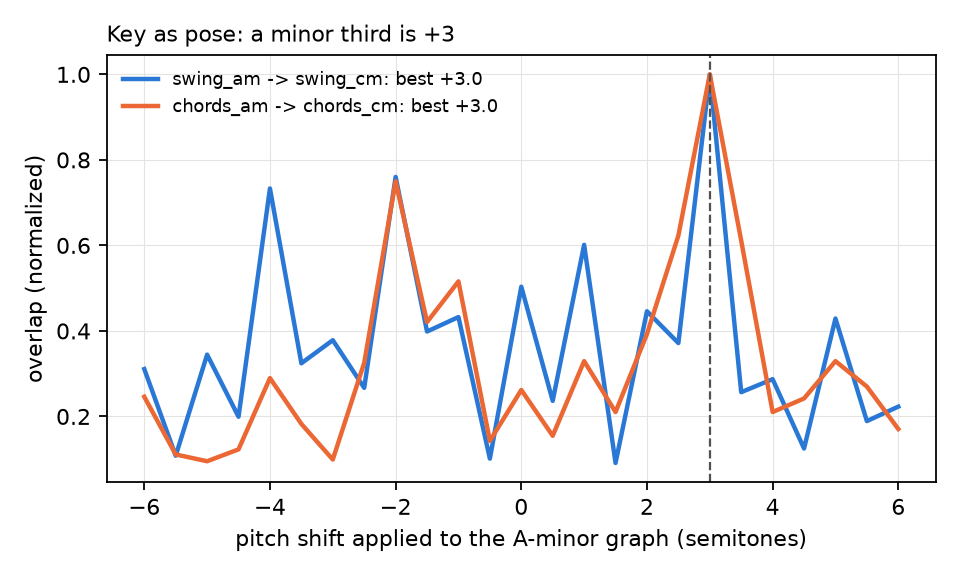
- A sound is a graph. x is the pitch period in octaves, y is the place on the cochlea, so the same riff in another key is the same graph shifted. Key is pose.
- Seven guitar takes, played by me: 7 of 7 on the clips it learned, 5 of 7 on later clips it was never given, 1 of 2 on C minor having only learned A minor.
- Every miss gets the tune right and the key or mode wrong.
- Same on v0.58 as in October: the same answers and the same step counts.
- Known limit: a held note is a single point, and stock evidence cannot say no on a feature mismatch.
How touch is wired into MuJoCo
- The world gets materials.
MuJoCoSimulator(materials=...)takes a table of friction and stiffness per object. Withconvex_decomposition=Trueeach object collides with convex pieces (CoACD), so the finger meets the surface the camera sees and not the hull around it. - The agent gets a fingertip.
TouchConfigon the surface agent adds a hidden sphere at the sensor. Every step its observation carries what the contact solver already worked out: whether it is touching, how hard, how deep, the contact point, and which way the surface faces. - Three readings are taken without moving anything. Grip is read by a virtual drag through the friction cone. Curvature comes from four virtual presses beside the contact. Texture is a virtual stroke over a recorded surface.
- The sensor module has no camera.
TouchSMmakes a percept from the contact: location is the contact point, pose is the contact normal plus the felt curvature directions, features are grip, stiffness, curvature, roughness and vibration. - The policy steers by touch.
TouchSurfacePolicyreaches until it touches, follows the surface, and goes back to the last touch when it slips off. - Everything after that is stock Monty.
DisplacementGraphLMlearns,EvidenceGraphLMrecognizes, and the eye and the finger are two columns that vote.
To run the small version (four objects, a few minutes):
uv sync --extra dev --extra simulator_mujoco --extra touch
uv run python run.py experiment=touch_both_pretrain
uv run python run.py experiment=touch_both_eval
uv run python run.py experiment=touch_both_eval_novel
uv run python run.py experiment=touch_only_pretrain      # the finger alone, no camera on the agent
uv run python run.py experiment=touch_only_eval
The 50-object experiments are touch50_*. They also need the Penn Haptic Texture Toolkit model files in $MONTY_DATA/hatt, which cannot be redistributed.
Limits
- One run per number. No seeds swept. Each 50-object number is 150 episodes (147 for the finger alone).
- I chose the materials. Each object’s friction and stiffness come from a table I filled in, and the finger reads them back with no noise.
- Texture is recorded, not simulated. It comes from models of a steel tool dragged over real surfaces, at one fixed light stroke. Which object gets which surface is my choice.
- The stock evaluation rotations are three of the training rotations. The new-rotation numbers are the fairer ones.
- Voting stops before the pose settles. Eye + finger mean rotation error is 21 degrees on trained rotations and 40.5 on new ones, against 2.2 and 8.5 for the eye alone. The medians are 0 and 7.8.
- The finger alone has gaps. It cannot learn the skillet lid, it confuses the two screwdrivers on new rotations, and texture by itself is the weakest of its senses (142 of 147).
- The 50-object runs were pretrained in 8 parallel pieces and merged, and the eye-alone row uses the eye column cut out of the voting model. The scripts for that are in my own repo, not in the fork.
The Q4 roadmap, in TBP’s words
The video: 2026/09 Q4 Research Roadmap. Places where it lines up with this work:
- 10:29 Jeff: run a fast learner that assumes everything is new beside a slow one that assumes everything is old, and decide later.
- 27:02 Niels: representing visual texture (“marble or fur”) is parked for now.
- 30:11 Jeff on touch: a finger moves slowly and continuously, with no saccades.
- 33:14 Jeff on sound: we parse it by events, the attack of a note.
- 42:33 Jeff: “You just keep groping around until you find something interesting.”
- 52:52 Niels: learning that is always happening, with no separate learn step, filed as nice to have.
- 71:33 Jeff: the cortex seems to need sleep to take in what the fast learner stored.
- 76:46 Niels: where does an object end, and how to represent that.
On this machine
- Results write-up with both tables:
/home/bryan/MontySAI/experiments/touch/README.md - The fork:
/home/bryan/MontySAI/tbp.monty(branchestouch-mujocoandaudio-sensor-module-v058) - The always-learning ear in REAPER:
/home/bryan/LMS/lms_monty.jsfx
 I occasionally reply to posts about ai on Instagram to tell people about the project and I want to tell them about what you’re doing just because it has happened so rapidly. It’s inspiring because you’re basically a smart hobbyist with a vivid imagination who quickly grasped the potential of Monty and had the software chops to put it to use, and there’s a lot of people out there like you. But just trying to describe the TBP is way too much for people to digest. I’m looking forward to seeing what the next wild thing you will have discovered when I’m done replacing all the front end parts